
Real Estate
Costa Rica Becomes a Paradise for Digital Nomads
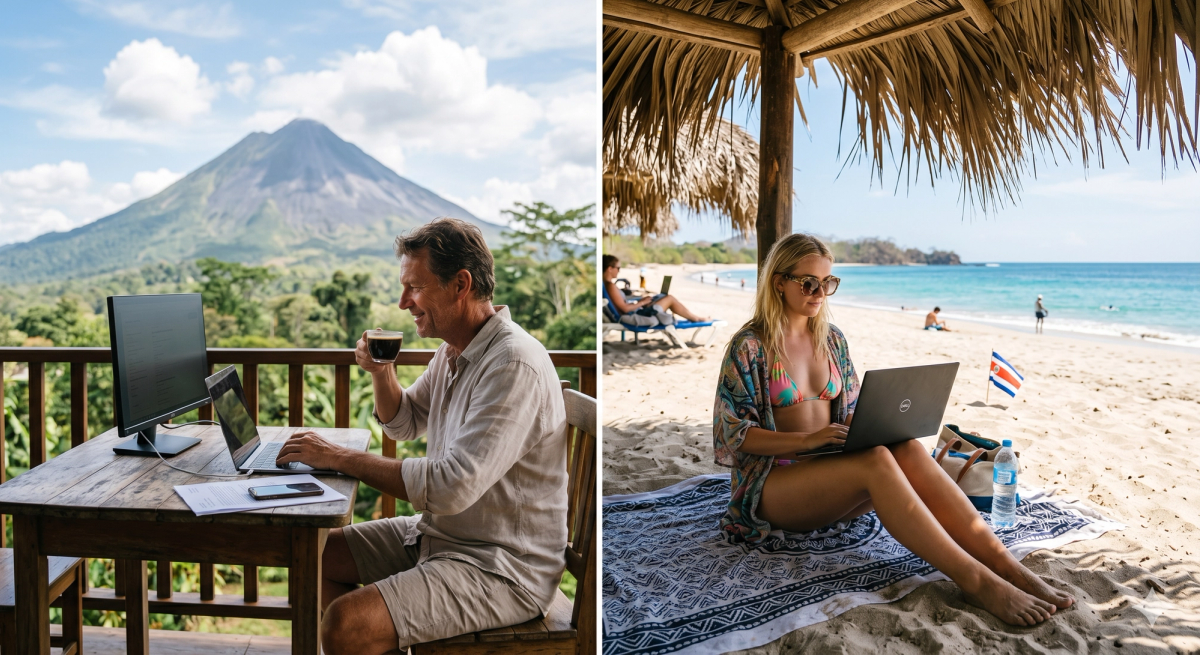
Teaching lessons from a paradisiacal beach, creating a financial budget at the foot of an imposing volcano, or translating a document from the depths of a beautiful cloud forest is possible in Costa Rica for any worker who provides services using IT, analogue, and telecommunications means, commonly known as “digital nomads.”
On July 8, 2022, Executive Decree No. 43619-H-MGP-TUR was published in the Official Gazette (La Gaceta), regarding Regulation No. 10,008, called the “Law to Attract Workers and Remote Service Providers of an International Nature.”
This document establishes the guidelines for the correct registration of these individuals and seeks economic reactivation alongside the four thousand digital nomads already living in the country. To qualify for this modality, these are the necessary requirements:
- Stay Duration: You must remain in the country for a minimum of 180 days during the first year, which can be extended for an additional year, for a total of two years.
- Income: You must receive a stable monthly remuneration, fixed income, or an average monthly income during the last year equal to or greater than $3,000. In the case of bringing a family group or dependents, the amount must be at least $4,000. Dependents include a spouse, parents, or single children under 25 who depend economically on the applicant, and children over 25 with a physical or cognitive condition (which must be proven by a medical report).
- Health Insurance: You will need a medical services policy with coverage for the entire duration of your stay in the territory.
Better Conditions and Facilities
Our country has made strides to ensure these individuals can carry out their activities in the best possible way while promoting tourism in Costa Rica—a practice implemented by nations like the United States or Portugal for a population expected to reach 1 billion people by 2035.
According to the most recent research by Newmark Central America, one of the world's leading real estate consulting firms, there are 16 coworking brands in Costa Rica and more than 21,500 m² of inventory space. These areas offer affordable memberships or packages that include high-speed internet and support, meeting rooms, and phone booths, among others. The hotel sector has also adapted, offering "workation" hybrids available on each hotel's official website.
Currently, there are two international airports with renovated and conditioned infrastructure: Juan Santamaría International Airport (SJO) in Alajuela, located 20 km from the capital, San José, and Daniel Oduber Quirós International Airport (LIR) in Liberia, Guanacaste—perfect for those looking to explore the Pacific coast and the northern part of the nation.
Another important detail is that remote workers are permitted to use their driver's license with total freedom within the country.
How to Apply
Those wishing to apply for the non-resident visa (stay subcategory: Remote Worker or Service Provider) must access the Trámite Ya portal, create a user, and complete the respective forms and affiliation. Once the request is received, the immigration authority has a period of five business days to review it. However, if the documentation is incomplete or defective, a period of eight business days will be granted to fulfill the requirements.